
Fear of a recession in the US due to rising unemployment has added to the concerns of India's IT services sector, which was seeing some growth returning after Q1FY25 results. The Nifty IT closed 3.26 per cent down, as major IT services companies' stock value fell. Tata Consultancy Services (TCS), India's largest IT services firm, saw its stock price fall 4 per cent during intraday trading.

The listed information technology (IT) subsidiaries of engineering giant Larsen & Toubro (L&T), LTIMindtree (LTIM) and L&T Technology Services, have seen sharp upmoves over the past fortnight, with returns ranging from 14 to 18 per cent. Both have outperformed the peer index, the National Stock Exchange Nifty IT, which has gained about 8 per cent, while the benchmark Nifty 50 is up 4 per cent during this period.

The new asset class (NAC) proposed by the market regulator could see diverse product offerings with high-risk strategies across equity and debt if the mutual fund (MF) industry's recommendations are incorporated into the final regulations. While the Securities and Exchange Board of India (Sebi) has suggested relaxations in investment norms for NAC compared to traditional MFs, some fund houses are advocating for further relaxations in concentration norms, greater flexibility in leverage, and the ability to invest in securities currently outside the MF domain, such as unlisted debt papers and debentures, sources reveal.

Global brokerage firm CLSA has reversed its early tactical shift from Indian equities to Chinese stocks, and has decided to raise India allocation while cutting exposure to China. In its report titled 'Pouncing Tiger, Prevaricating Dragon', CLSA cited challenges facing Chinese markets in the aftermath of Donald Trump's victory in the US elections as the reason for the move. "Misfortune can happen in threes. So it has played out for Chinese equities over the past week.

Among Sensex firms, Tata Consultancy Services, HCL Technologies, Tech Mahindra, Infosys, Mahindra & Mahindra and Tata Motors were the biggest gainers. UltraTech Cement, JSW Steel, Tata Steel, Adani Ports, Power Grid and Bajaj Finserv were among the laggards.

Among the 30 Sensex firms, Adani Ports and Power Grid climbed over 3 per cent each. Tata Steel, JSW Steel, Infosys, Mahindra & Mahindra, Maruti, and Larsen & Toubro were the other big gainers. IndusInd Bank, Bharti Airtel, Hindustan Unilever, Tech Mahindra and Titan were the laggards.

After lagging behind benchmarks and broader indices over the past five years, real estate investment trusts (Reits) have outperformed them since the start of 2024. The four listed Reits have posted an average return of 16 per cent year-to-date, compared to 9.9 per cent for the S&P BSE Sensex and 11 per cent for the National Stock Exchange Nifty.
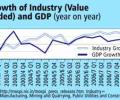
The case for a swift and sizable reduction in the repo rate rests on several pillars. First, and most importantly, there is mounting evidence that the five-year old surge in India's economic growth, especially industrial growth, peaked a few months back.

Among the Sensex firms, Titan, Asian Paints, ITC, Hindustan Unilever, Nestle India, Bajaj Finserv and Bharti Airtel were among the gainers. In contrast, UltraTech Cement, Tech Mahindra, Tata Steel, Power Grid, HDFC Bank, HCL Technology, State Bank of India and ICICI Bank were the laggards.

The IPO filing-to-approval lapsing ratio this year is the best in three years, underscoring the improvement in the IPO market's buoyancy.

S&P Global Ratings on Monday cut India's economic growth forecast for current fiscal year to 7 per cent, but said the domestic demand-led economy will be less impacted by the global slowdown. S&P had in September projected the Indian economy to grow 7.3 per cent in 2022-23 and 6.5 per cent in next fiscal year (2023-24). "The global slowdown will have less impact on domestic demand-led economies such as India... India's output will expand 7 per cent in fiscal year 2022-2023 and 6 per cent in next fiscal year," S&P Global Ratings Asia-Pacific chief economist Louis Kuijs said.

Those who consider the rupee as a proxy for virility have started thumping their chests and dreaming of dethroning the dollar from its coveted position, observes Tamal Bandyopadhyay.

Foreign portfolio investors (FPIs) have net sold domestic shares worth over $10 billion so far this month amid a shift to China, which not only offers attractive valuations compared to India but has also announced several measures to support the economy and the stock market in recent weeks. If the trend doesn't reverse, this will be the first time that overseas funds will yank out more than $10 billion from Indian equity markets in a month.

'Investors with foreign currency-denominated goals, such as foreign education or foreign travel, should go for US equity funds.'

Foreign investors continued their relentless selling in the Indian equity markets in August, offloading shares worth Rs 21,201 crore due to the unwinding of the yen carry trade, recession fears in the US and ongoing geopolitical conflicts. This came after an inflow of Rs 32,365 crore in July and Rs 26,565 crore in June, data with the depositories showed.

What makes Pushpa 2 float is Allu Arjun's magnetic performance. The actor really goes an extra mile to deliver the wildfire he promised, observes Mayur Sanap.

FMPs remain an option for investors who believe interest rates could head downward over time and wish to lock in the current rates. TMFs have very low expense ratios, which makes them cost-efficient.

Volkswagen Passenger Cars is targeting a volume sales growth of about 15 per cent in the country in 2024, even as it expects the Indian passenger vehicle (PV) industry to grow by 5-7 per cent in the current year, its India brand director, Ashish Gupta, said on Thursday. This means the company is expecting to grow 2-3 times faster than the Indian PV industry in 2024. But globally, the German automaker is expecting just 3 per cent rise in sales this year, down from 12 per cent last year.

Srinivas Bhogle and Purnendu Maji present Rediff.com's Most Valuable Player Index of IPL 2024 after Game 31.

From attractive EMIs to assured buyback guarantees, luxury carmakers have lined up a slew of offers to woo customers this festival season to address dwindling sales amid rising inventories.

Global firm Accenture's fourth quarter results prove that the worst is behind for the Indian information technology (IT) sector, said analysts on Friday (September 27). While the pace and the broadness of recovery is debatable, they said Accenture's results and revenue growth guidance for the next financial year (FY25) reduce downside risks for Indian IT companies.

India's thriving mutual fund (MF) industry is drawing interest from several firms, with multiple applications submitted to the Securities and Exchange Board of India (Sebi) for asset management company (AMC) licences.

The Reserve Bank on Monday advised banks to provide shade from the sun and water to customers waiting to exchange or deposit Rs 2,000 notes. It can be noted that during the note ban in 2016, there were allegations of customers dying while waiting in queues to exchange bank notes. Following Friday's announcement of withdrawing Rs 2,000 notes -- the notes continue to be legal tender unlike demonetisation exercise -- there were concerns about customers facing inconvenience, especially given the summer being at its peak.

After the massive tax evasion of GST by cryptocurrency service provider WazirX, the Directorate General of GST Intelligence has come down heavily on cryptocurrency exchanges operating in the country, said sources. "Around half a dozen offices of cryptocurrency service providers have been searched and massive Goods and Service Tax (GST) evasion has been detected by DGGI," sources told ANI. Crypto wallet and exchange are platforms where merchants and consumers can transact with digital assets like bitcoin, ethereum, ripple, etc.

Investors should view the increase in the LTCG tax rate in conjunction with the increase in capital gains exemption from Rs 1 lakh to Rs 1.25 lakh, which will provide some relief.

The data said the ED filed a total of 176 Enforcement Case Information Reports (ECIRs), equivalent to a police FIR, against existing and ex MPs, MLAs and MLCs which comes to 2.98 percentage of the total 5,906 such complaints filed since the law came into being.

Data for more than 100 countries over 47 years shows little sign that currency appreciation causes a dent in inflation levels.

The Reserve Bank of India (RBI) is expected to keep policy rates unchanged at a six-weekly rate review on Tuesday, ending a year-long cutting cycle as it focuses instead on underpinning the plunging currency.

Benchmark equity indices Sensex and Nifty declined nearly 1 per cent on Wednesday, falling for the fourth day running amid profit-taking by cautious investors ahead of the results of the Lok Sabha polls. The 30-share BSE Sensex declined 667.55 points or 0.89 per cent to settle at 74,502.90. It went below the 75,000 mark to hit the day's low of 74,454.55, plunging 715.9 points or 0.95 per cent.

After a $110 billion rout in market value, embattled Adani group got some reprieve on Tuesday after shares of most of its listed firms rebounded on bourses and international rating agencies said there was no credit risk for lenders with exposure to the group. The group, which is in the midst of a political storm after US-based short-seller Hindenburg Research's adverse report dated January 24 triggered a meltdown in group stocks wiping out billions of dollars in market value, also had a mixed day with the quarterly results of four of its entities, particularly Adani Ports and Special Economic Zone reporting a 12.94 per cent decline in consolidated net profit to Rs 1,336.51 crore for the December quarter 2022. Shares of flagship firm Adani Enterprises settled nearly 15 per cent higher at Rs 1,802.50 apiece while shares of Adani Wilmar jumped 5 per cent to end at Rs 399.40 on BSE.

Among Sensex shares, Hindustan Unilever, Bharti Airtel, Tech Mahindra, Infosys, Mahindra & Mahindra, ICICI Bank, ITC and Asian Paints were the biggest winners. On the other hand, Kotak Mahindra Bank, Reliance Industries, NTPC, UltraTech Cement and Power Grid were among the laggards.

'A 20 per cent equity allocation to ESG funds is a good start.' 'As more evidence on ESG performance builds, investors may increase allocations.'

Equity benchmark indices Sensex and Nifty hit their fresh record levels on Thursday after lower inflation numbers raised hopes of an interest rate cut by the RBI. Besides, heavy buying in capital goods, consumer durable and industrial stocks also helped the indices, traders said. Retail inflation continued its downward slide to reach a one-year low of 4.75 per cent in May due to a marginal decline of prices in the food basket and remained within the Reserve Bank's comfort zone of below 6 per cent, according to government data released on Wednesday.

India's gold and silver imports from its free trade agreement (FTA) partner UAE have skyrocketed 210 per cent to $10.7 billion in 2023-24 and there is a need to potentially revise the concessional customs duty rates under the pact to mitigate the arbitrage driving this surge, a report said on Monday. Economic think tank Global Trade Research Initiative (GTRI) said this sharp rise in gold and silver imports is primarily driven by import duty concessions granted by India to the UAE under the India-UAE Comprehensive Economic Partnership Agreement (CEPA).

More than 50 per cent of SIP accounts come from semi-urban and rural areas.

US's terrible political and economic leadership will ultimately cost the dollar its value. India must act early to avoid being dragged down, suggests R Jagannathan.

In the Sensex pack, Mahindra & Mahindra tanked over 6 per cent after the company cut the prices of its SUV models to boost demand. Mahindra & Mahindra said its XUV700's fully-loaded AX7 range now starts at Rs 19.49 lakh, a price cut of over Rs 2 lakh. Tata Steel, Tata Consultancy Services, HCL Technologies, State Bank of India, JSW Steel, Tata Motors and Kotak Mahindra Bank were other losers.

The Rs 84,000 crore domestic fund of funds (FoFs) space, which was in the doldrums over the past 18 months, has now caught the attention of investors due to a change in the tax structure in Budget 2024. The broader category, which includes offerings across equity, debt and commodities, has seen a spike in the inflows over the past two months. FoFs typically deploy the pooled capital in one or multiple MF schemes rather than investing directly into equities, debt or commodities.

While the minimum holding period for LTCG taxation has now been lowered, the tax outgo could be a bit higher under the new structure.

'Subject to any worldwide economic collapse.'
